
Introduction
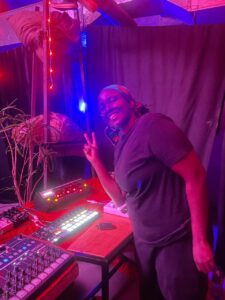
I’m taamuli. I’m based in Nairobi, and I’m a multidisciplinary visual and sound artist, though these days I lean more toward sound. I’m a nature lover, and music has always been central to my life.
I don’t have formal music training beyond piano lessons in primary school and a few violin and bass classes in university. Most of what I do is self-taught. I never fully connected with traditional music notation — scales, clefs, semiquavers — that system didn’t feel intuitive to me. But I’ve always heard music in layers. When I listen to a track, there’s often more happening in my head — harmonies, percussive variations, extensions of what’s already playing.
Percussion has been my most natural instrument. I’ve played drums, djembe, marimba, cowbells — that rhythmic language has always made sense to me.
I’ve also been chasing music for about twenty years — daytime concerts, nightclubs, festivals. I grew up in a household filled with African music — Lingala, Angelique Kidjo, Kenyan sounds — a lot of live instrumentation. My first exposure to electronic music came through radio in the 90s. Early Euro techno, house, upbeat dance tracks. It was different from what I heard at home, and that contrast stayed with me.
—
Why Techno
For me, techno is a metronome. It’s grounding. When I listen to Lingala or jazz, I can get lost in the dreamlike quality of it. Techno is different. It’s structured. It’s a timekeeper. It feels like a second heartbeat — one I can quantize through my ears. It reminds me that I’m here, in this physical space.
Techno events in Nairobi, especially dedicated spaces, feel free. I can show up and dance for five hours without pressure. There’s no need for constant conversation or social performance. It feels less competitive and less gatekept compared to some other scenes. It feels like community.
Techno isn’t always mainstream in Kenya. Before the pandemic, most of the techno I encountered was coming from outside the continent. Locally, deep house and Afro house were more prevalent. After lockdown, I started intentionally seeking out community again. That’s when I began discovering more dedicated techno spaces and collectives.
I think exposure is key. People tend to dance to what they first experience socially. If your early memories are tied to Afro house or Amapiano with your friends, that becomes your emotional reference point. Techno can feel niche, but I believe it’s simply less exposed.
—
How I Describe Techno to Newcomers
Techno is for dancing.
It’s less about lyrics and more about rhythm. You won’t find heavy narrative storytelling; you’ll find beats. Punchy, driving, layered beats. The BPM is faster. The energy is physical.
If you want to dance — not perform socially, not pose — just dance, techno offers that space.
—
Analog and Modular Practice
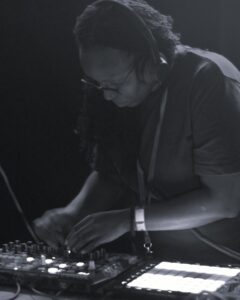
I work primarily with analog and semi-analog synthesizers. What draws me to them is that there’s no clear beginning or end. You’re generating sound live. You’re manipulating signals in real time. There’s no fixed timeline unless you impose one.
With digital production software, you often see waveforms — visual representations of sound. With analog gear, it’s just you and the knobs and your ears. That’s powerful for me because I’ve always processed music aurally, not visually.
My introduction to analog synthesizers came in 2020 when I was invited into a studio space. At first, I didn’t fully understand what was happening. But once I began experimenting — particularly with the Arturia MicroFreak — something clicked. I could shape sound live without needing to “see” it on a screen. I was just listening and responding.
I studied electrical engineering, so I understood signals conceptually — sine waves, square waves, oscillation — but I had only ever seen them on monitors. Hearing and manipulating them in real time was transformative.
My process is intuitive. I usually begin with percussion. For me, the beat is the spine of techno. Syncopation is the soul. Sometimes I build entire compositions just from layered percussion without touching melodic gear.
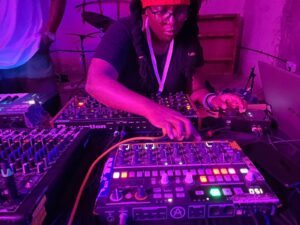
I don’t follow strict formulas. Often, after the initial setup, I enter a flow state. I adjust dials, apply reverb and distortion, shape sub frequencies — I’m a self-confessed sub-frequency abuser — and let the sound evolve.
I don’t always feel like I’m “making” the music. It feels like I’m closing a circuit. Like I’m the wire through which the signal passes.
—
Challenges in Kenya
Techno production locally is still emerging. Electronic music is widely loved in Nairobi — Afro house, Amapiano, deep house dominate — but techno specifically can feel inaccessible to some audiences.
Part of that is exposure. Part of it is how nightlife culture functions socially. Many people go out to socialize and talk. Techno invites immersion.
Another practical challenge is equipment access. Analog gear is expensive. I don’t currently own my own setup, and that limits consistency. Access to shared equipment, collective ownership models, and training programs would significantly strengthen this ecosystem.
There’s also hesitancy from venue owners when faced with unfamiliar formats, especially live setups without CDJs. But once they experience it, many become open.
—
Pros of Pursuing Live Analog Techno
The uniqueness of live analog sets has opened doors. I don’t use CDJs. I don’t mix through Serato. What I do is live production during performance.
That distinct approach has attracted bookings precisely because it offers something different. When audiences see live signal manipulation happening in front of them, it sparks curiosity.
There’s also strong potential in hybrid setups — integrating analog synths with traditional instruments or combining them with DJ sets. I’ve performed alongside DJs and traditional instrumentalists, and that layering creates something rich and unexpected.
—
Advice for Artists Exploring Analog and Modular
First, collaborate. The gear is expensive. Collective ownership is practical and empowering.
Second, talk to people already working in this space. Ask questions. Share knowledge. Experiment together.
Third, don’t feel guilty about imitation during learning. If you love a certain bassline or percussive pattern, try recreating it. Reverse engineering teaches you structure, and structure expands your creative vocabulary.
Most importantly, understand that your creativity is personal. The gear is just a tool. The signal is already inside you.
—
Looking Ahead
I’m releasing new music over the coming months. I’m curious to see how others categorize it because I don’t consciously work within subgenres. I create what feels right in the moment.
Five years from now, I hope to see more access to gear, more training spaces, more hybrid performances, and more openness to live analog production within Kenya’s electronic ecosystem.
At the end of the day, it’s all music. The tools may differ, but the impulse is the same — to generate signal, to move bodies, to connect.
And techno, for me, will always begin with the beat.
Instagram: https://www.instagram.com/taa.muli/