

In an era where underground electronic music is increasingly shaped by community, collaboration, and cultural exchange, new voices are redefining what the future of techno can look like. Among them is Femme Frequencies, a collective operating across borders and challenging conventional narratives around who gets seen, heard, and celebrated within the scene.

We spoke with Femme Frequencies about the realities of nurturing underground culture across continents, the importance of regional solidarity, and the possibilities that emerge when artists create their own pathways.
For readers discovering you for the first time, who is Femme Frequencies — and what core intention drives the collective?
Femme Frequencies is a platform dedicated to increasing visibility and creating opportunities for female techno DJs, both locally and globally. It was founded with the goal of supporting and strengthening the electronic music scene in East Africa while building meaningful connections with the global techno community.
At its core, Femme Frequencies exists to amplify female techno DJs, foster a stronger and more inclusive techno culture, and contribute to the growth of the East African techno scene.

(Founders: M4ryland and Anitraxx)
Femme Frequencies operates between Uganda and Oslo. How did this cross-continental identity form, and how has it shaped your sound and philosophy?
Femme Frequencies operates between Uganda and Oslo because of our founder’s connection to both places. This cross-continental identity formed naturally through movement, collaboration, and shared community. It has shaped our sound and philosophy by blending raw East African underground energy with the structured, experimental European scene creating a bridge between worlds.
What differences and similarities do you observe between the underground scenes in East Africa and Norway? Where do they challenge or inspire each other?
East Africa’s underground scene is growing fast; it’s hungry, experimental, and community-driven. Norway’s scene is more established, with stronger infrastructure and institutional support. The challenge in East Africa is access and space, while in Norway it’s about pushing boundaries. Both inspire each other: one brings urgency and growth, the other brings structure and sustainability.
You’ve collaborated with TCHNO and performed in Nairobi. What stood out to you about engaging with the Kenyan scene, and how do collaborations strengthen regional movements?
Collaborating with TCHNO and performing in Nairobi showed us how strong and connected the underground community is. There’s real passion and solidarity. Collaborations strengthen regional movements because they create visibility, shared audiences, and artist exchange helping us grow together instead of separately.
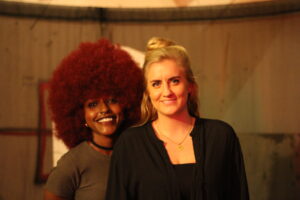
(Monrhea and M4ryland at TCHNO)
As a female techno collective, what structural gaps were you responding to when you formed? What did you feel was missing, and how are you actively reshaping that?
We formed in response to structural gaps: the male-dominated industry, lack of visibility for female techno DJs, and limited spaces to play this genre. Event organizers often prioritize more mainstream or familiar genres, leaving techno especially women in techno with fewer opportunities. We are actively reshaping that by creating our own platforms, curating our own lineups, and building a growing movement.
Beyond events and gigs, what are you building long-term? Education, mentorship, label work, touring circuits — what does the next phase look like for Femme Frequencies?
Our mission has expanded globally, but our goals remain the same: to create a strong platform for female techno DJs and uplift the East African scene. Long-term, we are building artist exchanges, DJ and production education, mentorship programs, future label work, touring circuits, and artist management. It’s about sustainability, not just events.
If you could define the future of women in underground techno in one intention or action, what would it be?
The future of women in underground techno is ownership. Owning our spaces, our sound, our platforms, and our networks. This is not just a project, it’s a movement, and it’s growing rapidly.

(NANGOBI, M4ryland, Goddess)
CONNECT TO FEMME FREQUENCIES: