

In September 2024, TCHNO Takeover at The Mist introduced us to DJ Cin.dyke, a Kenyan artist whose passion for techno extends far beyond the dancefloor. What began as intimate sets for friends in her house has evolved into a musical career spanning hotels and restaurants across the country. In this interview, DJ Cin.dyke shares her favorite genres of electronic music, the philosophy behind her “live the beats” tagline, and her grand vision for the burgeoning Kenyan techno scene.
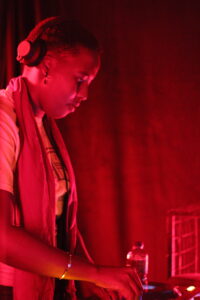
Furaha: Who is DJ Cin.dyke, how do you describe yourself?
DJ Cin.dyke: I describe myself as a versatile DJ. I play a lot of electronic music, but when it comes down to the nitty gritty of it. If a client approaches me and tells me they want a particular style, I try my best to curate that for them.
So my tagline is “live the beats” which means I live the beat of the moment. Like if you want hip-hop today, I’ll give you the best hip-hop set that I can.
If you want to dancehall tomorrow, I’ll give you that. But my baseline is electronic music.
And for electronic music, which genres do you enjoy playing?
DJ Cin.dyke: I play a lot of house, a lot of funky house. A lot of dance, a lot of techno. Trance in there, Drum and bass, dubstep.
Okay, that’s quite versatile. And in terms of techno, how did you discover techno because it’s not something that’s popular per se.
Yes, now when I was younger, when I started DJing, I had a lot of friends coming over to my house and bringing me music. That’s how I discovered electronic music. Someone introduced me to house music and then I started learning the various genres of house.
Then I discovered trance and techno. Yeah, so it was through friends that I discovered it.
And how long ago was this?
That was in university. My third year of Uni.
And for techno, like what do you like about techno?
I like the way there’s a certain feeling that you get when you listen to it, introspection. Like you sit down and you just start going into your thoughts and you just think as you listen to the music. You can call it a meditative state.
When I have those days I’m listening to techno, that’s mostly because I want to think about how things will flow.
Yeah, it makes a lot of sense. Before TCHNO Takeover, had you played techno gigs before?
I tried. When I was starting out as a DJ, when I went out into clubs, I went with my electronic music vibes. But back then, most clubs were not so receptive to it. So I tried, but it was more of a gamble.
They would say “okay that’s good music, but it’s not for this crowd. It’s white people’s music.”
I would get such comments later – no it’s too fast, it’s too deep, it’s not for now. So it was kind of hard getting a place to play.
That’s why I was a bit excited when TCHNO came about. I was like, okay, at least now this is a group where I can actually take my collection and play there.
And for your first show I remember you played tech house. And during this panel discussion we discussed the differences and similarities between techno and tech house. For you, what’s the connection between the two and what’s the differentiator?
I would still argue that tech house is techno, it’s a branch of techno. Because when you listen to it in them, there’s still a part that you’ll reach and then you’ll be like okay. Tech house will not be as fast as techno in some cases, but it’s still a branch of techno. Like techno will stem from there. Yeah, so I’m still for it.
And how was it playing at TCHNO Takeover? You can compare the first time in September and in January.
When I played the first time I was a bit nervous because I was coming with the tech-house and I had this whole argument. I was being defeated. But when I played it according to the crowd, everyone was receptive. And they were like “yeah, we like that.” It’s something we resonate with. So the first time was good .
Then the second time, I came with less tech house. I tried going deeper into techno. There was a lot of dark techno. I came in with more sub genres of techno and the crowd was also very receptive.
So I like the platform, the way you’re pushing for one thing. You’re trying to make people understand there’s this type of music and this is how it sounds, this is how it’s produced. These are the differences. So I like that. I’m hoping to play again.
So now that you’ve been part of TCHNO for a while, how do you see the techno scene in Kenya right now? Is it growing, is it the same?
I think it’s much better now than it was, let’s say, 10 years ago. Because 10 years ago you’d tell someone I play techno and they’d be like “okay, that’s just for you. Don’t play that out loud.”
But right now if you tell someone I’m a techno DJ they’d actually name a couple of places you can play at. So it’s definitely growing.
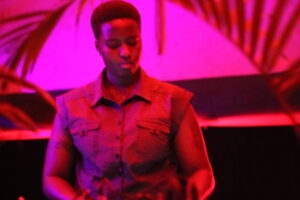
And where do you think we are going? With TCHNO, we’ve been exploring the different sub-genres of techno and working on production. And at Kilele Summit the focus was on how to create a Kenyan techno sound. So what do you think is the next step to grow this scene?
The way TCHNO produced some tracks during the maandamano (REFORM EP), that’s a good step. The next step from that would be to come up with a concert. Make a big concert and say it’s a strictly techno concert. You can get an international artist, you can get a local artist, do a big show, and take over the scene. Concert wise.
So far I’ve seen three groups doing techno and I think all of them can come together and say we want to do this one big show.
What do you think will be the impact of that?
It will definitely open minds to the different types of music that are there. Like all the different genres, not just techno or Afrohouse music. People will start thinking okay now I can play any other style. I can come up with genge, I can come up with drum and bass, I can do dubstep. You can open your mind and be free.
Like I said, techno is a lot of thinking. So if something like that were to happen, it would be big for the music industry. Outdoor with a huge stage for techno.
That’s a nice dream. And for yourself what are you looking forward to? What do you wanna do in the techno scene?
That’s a good and hard question, cause I’ve been dreaming for about 10 years. I’m still not in the scene as I’d like to be.
So I’m trying to push myself in all angles such that people know DJ Cin.dyke comes with the sound you require. But she has this one sound that is standard to her.
So my dream is to play at a concert and just see people happy. There’s a certain event that I play at almost every December at the Coast. Whatever style I bring is what they receive.
So my dream is to have that, not just once a year, but regularly. Yeah, so I’m trying to get regular shows to perform at.
And do you feel like last year there was more of that?
Yes, definitely. Last year (2024) was a good one for me in terms of bookings and everything. And this year has begun very well. So, I think I’m growing, not as fast as I would want to be, but there’s progress.
And who are your favorite techno DJs or producers? You could mention Kenyan and also international ones you look up to.
For international DJs, there’s one called Charlotte De Witte. She’s from Belgium Yeah, she’s quite good.
Yeah, and then there’s these producers called Drunken Kong who are also pretty good.
Then there’s Carl Cox for tech house. Yeah, he’s also amazing. Those are the ones I look up to.
Then locally, I’ve heard some stuff from Mawe which I think is pretty cool.
We’re still lacking the Kenyan edge, we need a local kind of sound.
And at Kilele Summit that was the focus. We had a panel discussion where we discussed how to make techno Kenyan. And then Mawe and [MONRHEA] created a sample track infusing Kenyan sounds. So it’s in the works.
Okay. Once we get there it will be good. We’ll be taking steps towards the concert.
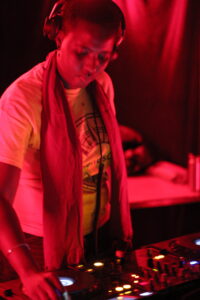
Listen to DJ Cin.dyke’s mixes on Soundcloud
Follow her techno journey on Instagram
Read about her tech-house DJ set at the 4th TCHNOversary at KODA Nairobi.