

Where did techno come from? Is it a white music genre birthed in Berlin? Or are there hidden black roots to this underground music scene?
One of our favourite DJs had a lot of music history to share with us during this insightful interview. Justin opened up about his journey from a Vinyl DJ to an electronic music DJ, how Detroit influenced American and European techno, and how Santuri Electronic Music Academy is bridging the gap between the two.
Get ready to learn a thing or two from Badman Bantou.
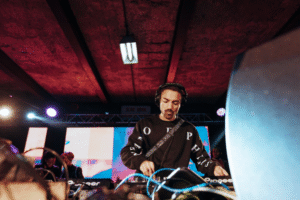
Hello, how are you today?
Doing pretty good, excited for this conversation.Just took a stroll around gather town.That was fun.
Nice. Do you mind introducing yourself?
Yeah, my name is Huilly Huile. I’m a DJ, radio show host. I work on various different projects, mostly music related and culture related. Based somewhere between Montreal and Nairobi.
So I’ve been working with the techno community here in Nairobi. And also people know me from Santuri projects, Santuri Electronic Music Academy. And yeah, I’m just interested in helping develop musical projects that, you know, make fun things happen, change the dynamics of things that are happening, allow good music to come out and reach people. And I facilitate people getting connected with great music events or great music opportunities. I like to work with audiences as much as I like to work with artists.
So yeah, that’s kind of it in a nutshell. I’m a fan of electronic music. I’m a club DJ, so that’s kind of where my passion for electronic music comes from.
Cool. You mentioned one of the spaces you have developed yourself is Canada. Do you mind sharing about your journey there and especially in relation to techno?
So I started out DJing something like six or seven years ago. I was playing vinyl records as a vinyl DJ. Probably one of the last ones to get paid club gigs to play vinyl. There’s still a few, but it’s harder and harder to do in clubs.
I used to play a lot of different music, mostly black music: soul, funk, R&B, hip-hop and jazz. And then at some point I started getting booked for more gigs, but promoters didn’t really want to pay for me to bring my whole record crate, set up my turntables. But they really wanted my selection and they were keen on having me play.
So I tried out using controllers, laptops, and a lot of the music that was available online just kind of became more accessible to me. And I started playing a lot more electronic stuff, edits, remixes. Then I started getting booked for more electronic gigs, a lot of Afro house, Afro beat, kuduro, Afro diasporic music, and dancehall.
And at the same time, I had other friends I knew from the vinyl scene, playing records and collecting records, who were starting to throw their own techno events. I had been going to those events for a while, but now that my friends were organising them, I just got interested in the type of community they were trying to build around techno music.
Shout out to Hell In Paradise from Montreal. They were doing a lot of techno, mixing it with 80s industrial music, playing with the fine line between the industrial music of the eighties, techno, and house. Really cool after hours parties that they used to throw.
They really inspired me to get into techno and I’ve always been a fan of the Detroit scene. Both the house music and then the techno that came out of Detroit. So I would say that’s what immediately made me interested in getting involved with techno. I see a lot of parallels between the things that I liked about the scene back in Montreal and the scene here in Nairobi.

Coming to know you for some time, I feel like you have so much knowledge in regards to techno music and the culture. Do you mind giving us your perspective of how the sound developed? Its origins, the influences, the American and the European scene, just like a grand scope of it.
Sure. I can try. You know, as much as I might seem knowledgeable to people in Nairobi, I’m not an expert or anything, I’m just enthusiastic about it. So I can give my perspective on it, but it’s by no means the opinion of somebody that is an expert or an authority on the subject. I’m just a fan.
So Detroit is a really interesting city to understand techno music through, especially American techno and black techno. Detroit used to have a booming industry of Motown, and a lot of the hit records of soul music were produced there. The industry was really massive, especially during the time where there were a lot of car companies operating in Detroit. And so a lot of people had jobs. The city was developing. They built a lot of infrastructure for the city and people had a lot of work, right?
But progressively the jobs got shipped elsewhere. The car companies and the infrastructure companies started to move to other parts of the country, and sometimes even other countries abroad. And so that meant that the black population of Detroit who didn’t have the opportunity of moving out or leaving were stuck there with a shell of a city, an empty shell. But the spirit of Motown and the spirit of soul music that was there stayed.
They were left with a city that was decaying, very connected to machinery and technology. And that coincided with a lot of electronic instruments that were accessible and affordable, hitting the market. Some of them were deemed as failures, like the 808, other drum machines, and synths that never really became respected in the music industry. They dropped in price and black people picked them up. They couldn’t afford elaborate studios with musicians and paying a whole band to do stuff. So they looked to these machines that allowed them to do a lot more with a smaller amount of space with a smaller setup and a smaller budget .
And even though they were using machines, the key thing about Detroit techno and black techno in general is that there’s a soul to it, and there’s a groove to it. It’s made with machines, but it’s not purely mechanical.
If you listen closely, you can hear that spirit, that soul, and the history of a community in that music. So I went over really quickly in broad strokes, but I think that’s how I would best describe it to somebody who maybe doesn’t know the history of black techno.
And I would just add that they were really influenced by the electronic sounds of European pioneers like Kraftwerk. And that was not just in the techno scene. The kraftwerk electro scene was also really influenced by people who were experimenting with electronic music, Afrika Bambaataa was sampling Kraftwerk and a lot of different electronic artists. And yeah, black people, black artists have always been on the forefront of repurposing, reinventing other forms of music. And hip hop has been doing that with the culture of sampling records and remixing.
So it’s a broader part of the black music tradition, but the way that it manifests in techno is one of the most important musical developments of the 20th century, if you ask me.
You know, I used to wonder why I would vibe so much with techno music, cause there’s this connotation that it’s white and all that. And once I discovered that black people are the ones who were at the forefront of pioneering this, it made sense.
Yeah, I mean, I find that that strain of techno that is from the US, from you know African Americans, is the one that moves me the most. It’s the one that makes me want to dance the most. So it’s like an aesthetic preference. But I think rather than say black people invented techno and it’s ours and we own it, I like to keep in mind that there’s just a long history of black and white musicians influencing each other and changing each other’s sounds intentionally and unintentionally, just by listening to each other’s stuff.
So a lot of European DJs were really influenced by the style of Detroit musicians. And it changed the way that they made music.
But the opposite also happened, right? Like I said, Kraftwerk is one of the biggest examples. They were making music with synths and drum machines in their own style. And it was very proper and German and they used to wear suits for their performances.
It tells you about the kind of thing that it was. It wasn’t rave music, that didn’t really exist as a concept at the time. But the fact that it was futuristic really spoke to black people and that’s what African Americans, when they were making techno, decided to get inspired from. It wasn’t being proper and wearing suits and performing that way, it was the futuristic aspect that they took and ran with in their own way.
They could have done other things. They could have tried to replicate funk music or soul music with electronics, and it would’ve sounded very different. But that is not what they tried to do .What they tried to do was to make a new style of music and tell new kinds of stories through the machines.
Through the SEMA course, you facilitated a film showcase that was talking about techno music, and we got insight into the Detroit techno scene. This is one of the ways you are spreading information about the underground scene and music in general. And being part of Santuri you’ve done so much of this.
Would you like to share ways you are facilitating the spread of music and culture and education to the scene?
Yeah, definitely. Thanks for asking and thanks for recognizing what we’re doing. I think both TCHNO and Santuri are on different ways of making a lot more art happen and evolve and develop. Both are involved in trying to support the development of artists.
So in the SEMA Film Club, which is something that we’ve organised for Santuri Electronic Music Academy, we try to give a bit of context so that people can not only get exposure, experience and inspiration from the people that are on the radio or have a lot of views on YouTube, but get the actual history. Because if you dig and if you’re interested in digging, you will find that there is a bit of information.
So we just tried to give a bit of background, extra information, historical context so that people can retrace music history, retrace technical styles, and know where the music lineage that they’re interested in comes from. And then they can be better informed to take it in the direction that they want.
Like I mentioned, when we hosted a screening for two short documentaries on black techno music for the Santuri Electronic Music Academy, we noted that most of the techno scene in Nairobi is influenced and inspired by a lot of European techno. And it’s mostly a lot of white techno.That doesn’t make it bad, but there’s a whole part of the spectrum that is missing in my opinion.
So we try to use SEMA Film Club as a way to share knowledge and get people inspired. And one of the movies that we screened was Black To Techno, which is a short documentary about Detroit. It’s very cinematic. It’s very aesthetically interesting. It’s directed by Jenn Nkiru who’s done music videos for Beyonce and Kamasi Washington.
Basically it was a bit of a poetic look at the history of Detroit techno and where it came from.
And the other movie that we screened was Techno City, which was focusing a little bit closer on the Detroit techno scene, but from the point of view of its pioneers. It’s a lot of interviews with some of the seminal figures of techno like Derrick May and Carl Craig. It was a very DIY film made in 2001.And it looks like it was made with a handheld camera.
Black To Techno was made in 2019, and it’s a high-budget production sponsored by Gucci and Frieze, big companies. So we gave two different perspectives on it, had a great conversation afterwards, and our students had so much to say and so many opinions. And it stirred up a lot of debate on what techno is, what it could be, what it means to us.
The more that we talk about these things, the more interesting our scene can get, because people can kind of understand the intention behind people’s artistry or people’s events. And people can join each other’s efforts based on knowing what the intention of the person is. Cause if you just say that you’re doing a techno event, like you see a lot of people doing in this city, I’m doing a techno event, I’m doing techno, then you go and hear tech house or whatever it is, EDM.
Everybody likes the idea of techno, but it’s important to know what it means to people and what they’re trying to do.
And then that way we have more synergy.
So what is your perspective of TCHNO concept and why are you involved so far?
I’m involved with TCHNO because I think it’s a sincere effort at making a community driven event. It’s very egalitarian. There’s no bullshit. It’s not about hype or fame.
I think the people who are involved are very committed. I’ve seen people put in a lot of hours to make something work and bring a vision to life. And the music is always exciting and refreshing, and it always expands my mind to go to a techno event and hear the music that’s played there.
It never sounds the same. And I don’t think you can say that about a lot of music projects and music events in the city. So that’s why I’m involved.
Would you like to share about Santuri East Africa and the jam session some of the music students in the academy participated in?
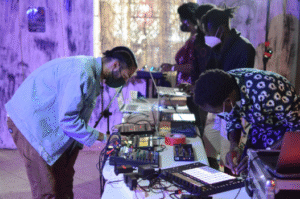
So we have an electronic music academy and we try to make different artists that are part of a cohort develop their artistic skills, develop their careers, their capacity as producers, recording engineers, and performers. And TCHNO was generous enough to share their space with us at Bambupelo Art Shrine on the third event with a really nice lineup of DJS.
Before the DJ set started, we brought a set of Maschine, Ableton Push, a few other pieces of hardware and some keyboards to let people do a live techno jam. And it was cool because though a lot of our students had been playing inside the box and doing production with various DAWs, they had never had access to hardware.
When you’re using your hands, when you’re standing, and when you’re playing with other people at the same time, there’s a bit more element of improvisation. And the rhythms that come out in the sounds that come out are different.
So it was a really great experience for us as Santuri. But for the students most of all, they said that they really enjoyed it. And we’re looking forward to doing it again, hopefully at the next TCHNO. I think the next live TCHNO jam is gonna be even better. And even more interesting.
And what do you think the current techno music scene in Kenya is from your perspective?
I don’t know if I’m qualified to talk about the whole scene because I feel like there’s a lot of people who just play in their bedrooms and release mixes online that we might not even know about.
But otherwise I feel like it’s a very niche thing, you know? The techno scene, like in a lot of places, is really catered towards middle class and upper class people. There’s very niche events.I feel like a lot of upper class, white and Indian people are running the techno scene and they’re really making it into kind of exclusive events.
Which is sometimes, very obviously, counter to the ethos of techno to begin with. It’s not meant to be a luxury culture, it’s meant to be a counterculture, a culture of resistance and defiance and emancipation. And it’s supposed to be something that is accessible to people. Not something that should be gate kept, you know.
So I think there’s really amazing projects going on. TCHNO is one of them. I’m sure there might be others we don’t know about and that we should connect with. But if things keep going the way they’re going now, it’s gonna develop in a really interesting way in Kenya.
That’s quite interesting. Because with TCHNO, we are trying to explore different ways we can take this sound further. And what are some of the ways you think we could take to progress this sound to stand the test of time and continue on and on and on?
What can we do to ensure the longevity of the scene? Use TCHNO, your event series as a guiding example. Make sure you put the needs of the music community at the forefront. Make sure it stays about the music and not about popularity or money or drugs. All of those things can be a part of the scene, but they should not be guiding it.
As long as we stay focused on that, then people who are doing techno music will be supported. They’ll keep creating, they’ll keep being inspired to make more music. That’s what I think needs to be done.
And I’m happy that there’s a community that is actively doing it in Nairobi. And I’m happy to be a part of it.
Yeah, we’re really really happy you’re here. I feel that you really are an influence on the direction this scene is going. And especially your involvement with TCHNO, so much gratitude for your involvement.
Thank you. That means a lot.
Honestly I do appreciate you and your efforts. And even when you share your musical knowledge with your sets, I’m glad you’re part of this guiding space as you called it.
Thank you for letting you be a part of it, you know? I’m really happy to see what TCHNO is becoming. It’s expanding conceptually at a really fast rate. Sometimes it’s even hard to keep up with the level at which ideas are being developed. And sometimes the ideas are so ahead of their time that you can’t really see where it’s going and it takes a bit of time for people to come around. And to realise how important a project like TCHNO is.
Interview by Monrhea