Techno Production


Tag
Insights

When The Story Stops: How DJ Storytelling Shapes The Politics of The Dancefloor

May 24, 2026

By Cheyenne Hanspal

At its best, the dancefloor was never simply a place to dance. It was a temporary
reorganization of reality — a space where identities loosened, time expanded, and new
forms of relation became possible through sound.

In the early days of house and techno, especially in Chicago basements and Detroit
warehouses, these spaces emerged not just as entertainment venues but as
infrastructures of survival for Black, and working-class communities excluded from
dominant social life. The dance floor offered more than escape. It offered the possibility of another way of being together as a community.

What made these spaces transformative was not only who occupied them, but how they
were structured through sound and time.

Today, however, something fundamental is shifting.

Across the global circuit of festivals and large-scale club events, the form of the night has
changed. Lineups now feature dozens of DJs playing tightly compressed 60–90 minute
sets. Music is increasingly optimized for immediacy: harder drops, faster pacing,
recognizable tracks and constant peaks.

The expectation is clear: capture attention instantly, sustain intensity continuously, and
never allow the energy to fall.

In this transition, something deeper than musical style is being lost. What is disappearing is the narrative function of DJing itself — and with it, part of the dance floor’s political and social potential.

The dance floor as a space of possibility

To understand what is at stake, we must return to the origins of the culture. The Techno
culture.

Figures like Frankie Knuckles and Larry Levan were not simply selectors of records. They were architects of temporal experiences. Their sets unfolded slowly across entire nights, guiding dancers through emotional states that could not be rushed.

These nights functioned as more than parties. They created conditions under which people could encounter themselves and others differently.

House music, as Honey Dijon has repeatedly emphasized, emerged from spaces of Black and queer resistance — spaces built precisely because mainstream society offered no room for those communities to exist freely.

Within these environments, the dancefloor became what queer theorist José Esteban
Muñoz described as a kind of utopian rehearsal: a temporary glimpse of a world not yet
fully realized.

But this possibility did not emerge abstractly. It was produced materially through listening, duration, and collective immersion.

DJing as Narrative and Relational Practice

In its original form, DJing was fundamentally narrative.

A set was not a sequence of tracks designed for immediate reaction. It was an unfolding
emotional architecture with gradual tension, unexpected detours, moments of intimacy, release, stillness, and return.

The DJ listened as much as they played. The crowd shaped the direction of the set
through movement, energy, and response. Together they formed a feedback loop — a
collective process of world-building through sound.

As Laurent Garnier has argued, a great set is about “telling a story, not just playing
records.”

That story required time. And time mattered politically.

Long-form immersion allowed trust to emerge between strangers. It allowed dancers to
settle into uncertainty, to move beyond self-consciousness, and to inhabit the space
collectively rather than merely consume it individually.

Listening became more than perception. It became relation.

Sound, unlike visual systems, resists fixed boundaries. It spills, overlaps, reverberates,
and dissolves distinctions between bodies. On the dance floor, this produced what
philosopher Salomé Voegelin describes as a plural and unstable field of possibility — a
space where identity could become fluid rather than fixed, where people encountered one another not through rigid categories but through shared sensation and collective duration.

The political power of the dance floor emerged precisely from this openness.

The Rise of the “Banger Economy”

Today, that openness is increasingly under pressure.

Large-scale festivals and commercial club circuits have reorganized DJ culture around
acceleration, visibility, and spectacle. Instead of immersion, we encounter compression.
Instead of journeys, we encounter sequences of peaks engineered for immediate impact.

DVS1 has been one of the clearest critics of this transformation. Reflecting on the
“ festivalization ” of techno, he argues that DJs are increasingly incentivized to chase
singular moments of reaction rather than construct long-form experiences.

This dynamic has produced what many describe as a “banger economy”: a system where tracks are valued according to instant recognizability, crowd response, and viral circulation.

The result is not simply aesthetic homogenization. It is a collapse of temporal depth itself.

Sets become interchangeable. Risk disappears. Ambiguity disappears. Silence
disappears.

And with their disappearance, the dancefloor loses some of its capacity to generate
alternative social relations.

The Politics of Time

At the center of this transformation lies a deeper political question: the organization of
time.

Earlier underground scenes operated according to a more fluid temporality. Nights
stretched unpredictably. Energy rose and fell organically. Time was inhabited rather than
managed.

Contemporary festival culture increasingly mirrors the logic of late capitalism: optimization, efficiency, segmentation, constant stimulation.

As Guy Debord argued, modern capitalism transforms lived experience into spectacle —
something consumed externally rather than inhabited collectively.

On the dance floor, this logic manifests in subtle but powerful ways.

Shorter sets interrupt emotional continuity. Without continuity, trust weakens. Without trust, vulnerability becomes more difficult. The conditions that once enabled queer expression, interracial intimacy, emotional risk, and collective release become increasingly fragile.

What remains is often an experience of surface intensity without deeper transformation:
visually spectacular, sonically relentless, but extremely thin at the social level.

The issue is not simply that music has become faster or harder. The issue is that
acceleration leaves little room for listening.

And listening — in its deepest sense — is what once allowed the dance floor to exceed the logic of consumption.

When the Story Stops

The disappearance of storytelling has consequences beyond music itself.

Narrative DJing created continuity. Continuity created relational depth. Through that depth, dancers could temporarily escape the fixed identities and social roles imposed outside the club.

The dance floor became political not because it represented ideology directly, but because it enabled the experience of plurality — the sensation that reality itself could be organized differently.

.Without sustained narrative: the crowd resets every hour, immersion fragments, emotional memory weakens, and collective experience becomes increasingly difficult to sustain.

As Ben UFO has noted, environments built around constant intensity often leave little room for exploration, subtlety, or genuine diversity in sound.

The dance floor risks becoming less a participatory social space and more a consumable audiovisual product.

Resistance in the Underground

Yet this transformation is not total.

Across smaller scenes and community-led spaces, artists and collectives continue
resisting the acceleration of club culture. All-night-long sets are returning. Intimate venues are prioritizing curation over scale, immersion over spectacle, and listening over constant stimulation.

Figures like Honey Dijon and DVS1 continue advocating not for nostalgia, but for the
preservation of the social and political conditions that once made underground culture
transformative.

What is at stake is not simply how music is played, but what kinds of worlds become
possible through it.

The Future of the Dance floor

If early house and techno culture offered the dance floor as a site of political and emotional possibility, then the current moment forces an urgent question:

Can spaces of collective transformation survive under conditions of acceleration,
commodification, and spectacle ?

Or, put differently: If the story disappears, what happens to the world it once allowed
people to imagine together ?

Perhaps the answer lies in reclaiming time itself: stretching it, slowing it down, allowing
silence, uncertainty, allowing sound once again to breathe.

Because the politics of the underground were never only about representation or identity.

They were about creating conditions where something else could emerge between people— fleetingly, imperfectly, but genuinely — through time, intentional listening, and shared presence.

And that remains a possibility worth protecting.

Interviews

The Evolution of Budalagi and Insights on Building Nairobi’s Techno Scene

March 22, 2026

Monrhea: Kindly introduce yourself.

Budalagi: I am Felix Mwita, aka Budalagi, and I am a DJ, Producer, and cultural worker based in Nairobi.

Monrhea: Why “Budalagi”?

Budalagi: Budalagi comes from my gamer tag. Not too long ago I was deep in the online gaming community. I played a lot of GTA—before the pandemic and especially during it. That’s basically all I did beyond school: make music and play games. And I didn’t have the best Internet, so when you’re playing with your friends, the stream would lag a lot. To sum it up, my gamer tag came from my city Internet connection.

Does that “lag” interpret anywhere else in your life—maybe the scene, maybe your journey?

I can definitely get philosophical about that. For me it was about the lagginess—the uptake. When I was starting out, I had a very specific point of view in terms of the music I wanted to hear. I was looking around while making my own music. I’m very introverted, so all I did was go to school, make music, and keep an ear out for parties I’d actually feel comfortable attending. There weren’t many. Some were close to what I wanted to hear, but eventually I had to accept that there’s no perfectly fitting love for you musically—you have to make it. So it became about compromise: finding something aligned enough to be a gateway to what I envisioned.

I wouldn’t say the scene was lagging, but I felt like, “Come on, there’s so much more out there.” More to explore. More sounds to hear beyond the usual. So for me, the lag was collective—this comfort zone, the lack of progressive progressiveness. You’re lagging.

The scene isn’t necessarily lagging in the obvious sense. But personally, I’m aware that I might be lagging in some respects. I have a vision, a mission, an emotional point I want the Nairobi scene to reach. And I feel like that might be lagging too.

So the lag is twofold: frustrations with the scene, and my own stubbornness—this refusal to accept or conform to experiences or emotions that don’t speak to me. I will always lag behind when it comes to conforming to things misaligned with my spirit.

Were you always into electronic music? What’s your story?

My earliest experiences with music were through the radio. My folks had one at home, and whatever they played is what you listened to. A lot of Lingala, old Congolese jazz—my dad loved that. From there it progressed to TV. We had shows like The Beat and other afternoon music shows. I’d come home from school and that’s what would be on. Over time, the music shifted more toward house—music with vibe and flow. And something sparked in me. The intros, the kick, the heartbeat—it was structured, groovy, and it spoke to me. But I didn’t have the language for electronic music yet.

In those days, the exposure was very mainstream. You’d hear an Avicii tune here, some mid-2000s pop-electronic there, Europop influences. There was also what people here called “old school house”—something DJs leaned into. It resonated because it had been popular in the ’90s and ’80s, so our parents had some connection to it. From there, I realized there was this whole world of music built around a four-on-the-floor beat, a kick, a club heart in the bassline, synths. I just kept digging.

I discovered techno and all its subgenres. And I never settled. I’m always curious—looking for the next mutation of the music. I’ve always struggled with the idea of picking one niche subgenre and staying there forever.

Whatever’s in your mind, you can translate it into music. That’s what production became for me: satisfying myself. Making the kind of music I want to hear. Music that speaks to me deeper than words. It became self-expression, a reflection of my taste and identity.

At the core, that’s what artists do—we express ourselves. It’s deeply gratifying to create music I genuinely believe in. And I’ve been intentional about playing my own tracks in my sets. That was always the plan: make music I want to hear played out. That’s my journey, and it’s still evolving.

But once I started making music, I quickly encountered the challenges of navigating a system not always built for artists like me. And then you have to decide: am I going to be helpless and cry about it, or am I going to do something?

So now I’m working on multiple fronts: making music, engaging with the cultural side, the industry side, finding a balance between making the art and shaping the ecosystem around it. It’s not easy. But it’s necessary. That’s just the reality.


Let’s dive deeper into techno.

Mm-hmm.

How would you explain techno to someone, especially the sub-genres you play?

Experiential. It’s an experience before it’s a genre. The sound I play sits in that deep, hypnotic, raw pocket. Very percussive. Very groove-driven. Hard-groove adjacent, if you’re doing your research. But the truth is: it’s contextual. Techno needs a curated space and a curated crowd. The experience makes the music as much as the music makes the experience. My sound is raw, groovy, deep, intricate. Emotional too. When I’m playing, it feels instinctive—almost like going back to something natural.

Techno can also appeal to introverts.

Exactly. It celebrates individualism as much as it celebrates collectivism. Wherever you sit on that spectrum, there’s room for you. In those dark rooms—lit or unlit—no one cares about how you look dancing. The crowd is connected to the music, and people lose themselves in it. It works beautifully for introverts.

From a production point of view—what makes a groove?

For me, it’s polyrhythms. Groove is in the unpredictability. Percussion and syncopation—those are the engines. Syncopation lets you push past familiar patterns. A lot of African music is heavily syncopated and groove-heavy, and that irregularity is something I pull from. If you produce strictly on the grid, it becomes robotic. I try to bring the human element back—drumming live on a Push, tapping rhythms in with my hands.

Everything in the track speaks to each other. The kick talks to the bass. The bass responds to a hat or a stab. You feel when it’s groovy versus linear. Some techno swings heavily; some is rigid and mechanical. I lean toward the swung side because it gets you moving, swaying. And that sway is the heartbeat of techno.

And syncopation—how would you explain it?

At its simplest, it’s one element speaking to another. Call and response. A kick hitting here, a clap landing there, but not where you’d traditionally expect it. It’s hard to explain without demonstrating it, but it’s basically shifting things off the grid so they converse. You can look up the textbook definition, but beyond that, syncopation is the refusal to be linear.

Let’s get into history. You’ve been around the Nairobi scene for a while. What’s your read on the history of techno here—pre-lockdown and post-lockdown?

My first point of reference is Temple and Shelter. That’s where the modern Nairobi techno story starts. A Filipino guy—I’m blanking on his name—introduced that techno night to the city. It was new, novel, fresh. There might’ve been earlier pockets, but Temple was the one that created an actual structure around it.

Around the same time, there was a deep house wave happening—the precursor to the Gondwana era—and that fed into the Afro-house scene we know now. For techno though, Temple was the launchpad. They even did house nights, but the techno nights became the core. That novelty kept it rising until it peaked—right before the pandemic. Those were the golden years.

Temple at its prime was true to the ethos: people expressing themselves freely, dancing, converging, sustaining a culture. It coincided with Nairobi’s EDM golden age, so electronic music in general had oxygen.

Then the demographic shifted. The early adopters got jobs, responsibilities, kids—life pulled them away. Not an excuse; in other places people rave into their fifties without blinking. But here, that first crowd fragmented. Some moved to Afro-house, some drifted into other scenes, some disappeared entirely.

Temple paused, and suddenly techno had no home. People resorted to house parties or even traveling to Europe to hear the sound they loved. Without a regular venue or party series, the culture stalled. Meanwhile, Afro-house grew fast because it was more accessible and more consistent. Every weekend you’d find an event. Techno? Maybe once a month—if that. And without frequency, you don’t get converts.

Now we’re in a second resurgence. A new wave of people want a space for this music—and some of the old heads want to return, or at least pass the baton. But it’s essentially rebuilding from scratch. Without continuity, you have to re-educate, re-contextualize, re-create the culture. Your production sessions, your listening sessions—those give people an entry point. Techno needs that.

So the arc is: novelty, growth, peak, fizzle, fragmentation, and now resurgence.

What makes other scenes work—and what can techno borrow as it rebuilds?

Sustainability comes from a broad user base. Enough people to keep events alive every weekend. Accessibility plays a huge role, and that’s tied to the sonic aesthetic. Afro-house, for example, is easier to uptake for someone encountering electronic music for the first time. I overheard someone once saying during a techno set, “She hasn’t changed the music in ten minutes.” That’s someone who can’t yet hear the layers, the story. They hear a block of sound, not a progression.

Techno asks more of a listener. It’s abrasive, adventurous, unconventional. For someone encountering it for the first time, it’s either “What is this? I want more,” or “This is too much.” And unless there’s regular exposure, that spark doesn’t happen often enough.

Other scenes win through accessibility, regularity, and a culture that welcomes newcomers easily. Afro-house events happen weekly. Techno parties are sporadic. So the probability of encountering techno—and becoming a fan—is low.

Then there’s marketing. Amapiano events look flashy. Afro-house events look warm and communal. Techno flyers usually speak in that “if you know, you know” language. Which is authentic to the ethos, but not always sustainable here. In an ideal world, techno wouldn’t need marketing at all. The community would be the magnet. But Nairobi isn’t there yet.

So it’s sociocultural. It’s systemic. It takes intentionality to enter techno. People like hype, spectacle, belonging. Techno doesn’t sell itself that way by design. And that’s the tension.

Still, the resurgence is real. And the work now is building context, building community, and building continuity—so the culture doesn’t evaporate again.

Connect: Instagram

News

RHEINA Makes Techno History with Kenya’s First-Ever Solo Techno EP on Her Label, TCHNO Archives

February 14, 2026

Kenyan techno artist RHEINA unveils REIGN, a five-track techno EP that moves with raw, dark, hypnotic force. Featuring four original productions and a bonus techno remix, the EP channels rolling grooves, driving basslines, and stripped-back intensity. The sound is made for the underground, perfect for late-night dancefloors and immersive sound systems.

Reign marks a historic moment for the Kenyan techno scene: it is the first solo techno EP by a Kenyan artist on Kenyan Techno Label, TCHNO ARCHIVES, and makes RHEINA the first female techno producer to do so. The release follows [RE]FORM (2024), the label’s inaugural collaborative EP commemorating Kenya’s historic Gen Z protests.

Rooted in deep hypnotic techno, the EP balances grit with precision—locking rhythms, purposeful low-end pressure, and subtle acid touches. Emotion and power coexist throughout. Reign isn’t just heard—it’s felt, commanding the floor with authority and leaving a lasting imprint long after the final beat fades.

“This EP represents the beginning of an era,” she says. “It’s my first techno EP, where the intention was to understand the fundamentals of techno production. It’s introspective as well as energetic—and I’m proud to present Kenya’s first solo techno EP. Kenya’s techno production story starts here.” It also demonstrates the possibility of bridging the gap between Afro house and techno through the bonus track: a techno-leaning remix of an Afro Tech piece, El Geyo by Kamushez, that lets both worlds speak without losing identity.

Described as “deeply intellectually stimulating with relentless energy, a dark-captivating atmosphere and experimental influences,” Thee Techno Cat continues to emerge as a catalytic voice in contemporary techno. Beyond her international work under [MONRHEA], and appearances on platforms such as Sónar Festival and Boiler Room, she remains a driving force behind Nairobi’s techno scene as the founder of TCHNO and a committed advocate for education, inclusivity, and artistic growth.

With Reign, RHEINA doesn’t just release music—she lays a marker.

Tracklist:

  1. Reign
  2. Inner Reign
  3. Silent Reign
  4. Echoes of Reign
  5. Kamushez – El Geyo (Remix by RHEINA)

Connect with RHEINA on Instagram 

Listen to REIGN: https://linktr.ee/rheina.techno

Interviews

Inside the Modular Mind of Jaba Jesus

May 6, 2025

In this insightful interview, the Jaba Jesus delves into their evolving creative process, revealing how modular synthesis, rhythm, and emotion shape their sound. Drawing from a background in alternative rock and a passion for polyrhythmic complexity, they discuss how movement and improvisation are at the heart of their music-making. 

To kick things off, could you walk us through your creative process when working on a new track, especially when using modular synthesis?

Sure. These days, I try not to overthink it, which has been a shift for me. I used to feel like I couldn’t quite conceptualize how to make a piece of music—it felt abstract. But now, I approach it more like a math problem. There’s a need for elements of repetition, obviously. But within that repetition, I want movement, you know?

It’s almost like creating two equations that function together. The first essential element for me is movement. It’s a subliminal feeling, really—one of the most natural reactions to sound. It gives a sense of displacement or just a shift, and it’s powerful.

The issue with using a digital audio workstation (DAW) is that you’re confined to this four-by-four grid. But music wasn’t made to be confined like that. If you and I were to just sit down and say, “Let’s make music in a grid,” it wouldn’t feel right, you know? There’s something limiting about that rigidity.

So for me, I start with movement. Then, I layer in emotion, often through the bassline. I typically build around those two elements. Sometimes I’ll use a synth or a lead, but I prefer starting with the bass—it gives me that emotional depth I’m looking for.

Interesting. So, do you always start with rhythm, then?

Yeah, most of the time I start with rhythm. Bass and percussion form the rhythm section, so I focus there first. For example, I might want to create a polyrhythmic pattern, but it’s actually quite difficult to pull off on just one drum machine. To achieve true polyrhythm, you really need two machines, like running a triplet within a 16/4 pattern. It’s a lot easier to experiment with that kind of complexity on a drum machine or in Ableton.

I think of it as creating a rhythm in motion. Imagine if there were three of us sitting around with drums, playing a syncopated rhythm. For it to sound rhythmic, we’d need to create something called a circular rhythm, making space for every element so they don’t clash. There’s this whole algorithmic side to it too. They even did a research paper showing how an algorithm could generate traditional music by spacing out elements and balancing repetition. Once you get a base pattern, you can overlay another pattern on top of it.

So your melody or whatever is repeating, let’s say every 12 beats. But in techno, you need that little bit of variation. Even if the beat is hard, it has to have that slight volumetric shift, where one pattern might be on a 16th, and another on a 12th, or even a three. It’s that primal sense of rhythm.

Fascinating. And how do you balance your DJ sets with your modular sets?

Honestly, there’s no real balance between the two—they’re completely different approaches. With DJing, you’re looking for loops; you’re curating and blending pre-made tracks to create a vibe. But with modular, you’re creating the music on the spot. You’re essentially composing as you go, paying attention to every detail and reacting to the sounds in real-time.

How do you compare improvisation in your live performances?

Improvisation is where new music is made. I mean, where does improvisation come from? I don’t believe things are improvised, per se; it’s more like you’re realizing probabilities and building on what’s already there, trying different options. It’s weird. 

For me, it’s about playing something live, like a pattern, and exploring within it. I think of it as exploring emotions or syntax. The notes might be simple, but they have to be in the right place to feel right.

What are your early influences in music? Was it the first piano lessons, or something else?

I started playing guitar at 16, covering bands like Nirvana. It was the late 90s, all about alternative and grunge music. That phase helped me understand music as an emotional syntax. It wasn’t about technique but conveying emotion. Music is a language, and each note and harmony tells a story.

When did you decide to pursue music as a career?

Since I started, I never thought I’d do anything else. I always had the desire to be a musician.

Do you remember your first big gig?

Yeah, it was New Year’s for the millennium. It felt surreal to be paid for performing, almost like a dream.

Which of your tracks has had the biggest impact in terms of audience response?

It’s interesting because I didn’t have any feedback until I put something out. Seeing people react through playlists and analytics is unexpected and great. I was on a Tidal playlist called “African Space Program” with two tracks, Coco Sunshine and another Afrobeat track I did with my friend Sammy Son in Berlin. The response was surprising because I didn’t plan on going in that direction.

How did your collaboration with Edu Madoxx come about?

I just emailed him in 2020 during COVID. He replied a year later, and then we worked through the label. I was in Berlin while he recorded vocals, which I arranged into the song. It was a collaboration across distance, but it worked out.

Are there any other collaborations you’d like to pursue?

There are so many I’d love to do, but the best collaborations happen in the studio, just diving in and creating on the spot.

How do you stay inspired in the electronic music scene?

Meeting other producers and musicians, seeing different techniques and perspectives—that’s what keeps me inspired.

Any local Kenyan music scenes or communities you resonate with?

Yes, Kenyan rhythms and patterns are amazing. Kenya has all these unique rhythms that are almost like techno. The complexity and tempo give it a lot of room for creativity, and it’s something I like to explore in my work.

What advice would you give to emerging artists?

Don’t hold back—release your music and collaborate. Make a habit of producing with a goal, like an album or an EP, and set time limits to finish projects. Don’t judge the work too early; focus on the feeling it gives you. And get feedback, even from random listeners—they’ll give you a fresh perspective. 

Interview by Caleb Kiteme

News

TCHNO Releases their first Kenyan Techno Inspired EP: [RE]FORM

December 6, 2024

Kenyan techno collective TCHNO, announced the release of [RE]FORM, Kenya’s first-ever techno EP. More than music, it’s a tribute to Kenya’s fallen heroes, a celebration of resilience, and a declaration of liberation. [RE]FORM marks the beginning of Kenya’s techno history, ushering in a bold new era for the scene.

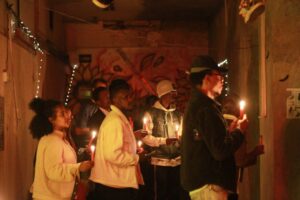
The EP emerged from TCHNO Circle, a special edition of the monthly TCHNO Takeover gatherings held at The Mist, an underground club in Nairobi. Against the historic youth-led maandamano (protests) in June 2024, TCHNO Circle created a communal healing space to honor Kenya’s fallen heroes with a candlelit vigil. The highlight was a collaborative music circle, where community members contributed their sounds of freedom. The result is five original techno tracks featuring four primary Kenyan producers and one vocalist – forming Kenya’s debut techno EP. 

Candlelit Vigil for the fallen heroes during the protests

Track Highlights

  1. Nairobi Circle featuring Mawe: A moving tribute to Kenya’s fallen heroes, blending haunting melodies with immersive beats to honor their sacrifice. 
  2. Coastal Circle featuring HEKA: A collaborative masterpiece uniting coastal-based artists HEKA, Kenia, Wangtekch and [MONRHEA] to create a track rich in cultural fusion and spirit.  
  3. Saba Saba featuring [MONRHEA]: A revolutionary track sampling the sounds of Nairobi’s Saba Saba Day celebrations, showcasing the unyielding resilience of Kenyan citizens. 
  4. Resistance featuring Jaba Jesus: Reimagined analog recordings from the TCHNO Circle sessions, offering a bold, fresh perspective on live techno production. 
  5. Freedom Affirmation featuring Furaha: A powerful affirmation of freedom featuring Furaha’s ethereal vocals layered over airy, liberating rhythms.  

The EP was mastered by Black Techno Matters, a global advocate for Black techno music. This collaboration was divine, as their mission celebrates liberation and empowerment, while reclaiming techno as a powerful expression that honors its Black roots.

Artist: TCHNOCRATS

Label: TCHNO

EP: [RE]Form  

Release Date: 6th December 2024  

INDEPENDENT RELEASE (BANDCAMP)

Stream and Buy [RE]Form on Bandcamp

Interviews

Makossiri: “I love following and trusting my intuition when it comes to producing music”

June 6, 2022

We’ve talked to a couple of Kenyan techno DJs, but what about techno music producers? Do they exist?

Born in Nairobi, spent time in Kampala, and now based in Berlin… Makossiri is a one-of-a-kind East African electronic music DJ and producer. Starting out as a live acoustic musician, she found her true sound in dark hardcore techno. She calls it Afro-future-tech. 

The daring multidisciplinary artist dropped her debut EP Juicy Juicy in October 2021 under  Ugandan label Hakuna Kulala. 2023 has already been an eventful year for her. After performing at Berlin’s CTM Festival and playing a guest mix for PAM Club, she released her next experimental EP under Ginene Records.

TCHNOCRATS, meet Makossiri.

Tell us about yourself.

I am Makossiri and I’m an Artist. I express myself artistically in different ways such as performance, deejaying, music production, and fashion. Lately, I‘ve also been experimenting with installation art as a medium for performance. 

How did you get into the underground music scene?

My journey into the underground music scene started around 2016 when I was hanging out at The Alchemist, which was a new venue in Nairobi at that time hosting underground electronic music events. Lots of artists and key players in the East African electronic music scene would hang out there too. I later moved to Kampala and got more involved in the underground music scene there through organizing music and fashion events, deejaying and producing music.

And how did you get into music production?

I studied Music Production in school for a year in 2016 but I really hadn‘t found my sound yet so I kind of shoved it in the backburner. It was until when the pandemic happened in 2020 that I got back to it more seriously. At that time I had already gotten into electronic music through deejaying and discovered what I really liked musically. This renewed my interest in music production and it has become part of me since then.

Do you have a specific production process?

I love following and trusting my intuition when it comes to producing music. And just vibe with the feeling or mood.  I‘m in at that particular moment.

Who do you look up to in terms of production and why?

There are so many producers that I look up to, but my favorites are Slikback (Kenya), Nkisi (Congo-Belgium) and Scotch Rolex (Japan). I love their experimental approach to club music.

You produce afrofuture tech which is a sub- genre of techno, what is techno music to you and what lures you to the sound?

To me, Techno is the sound of freedom. The sound that gets me to let go. Forget who else is in the room, just immerse myself in the music and have a good time.

Are there elements in techno music that inspire your productions?

Yes. I really like the 909 drum sounds  and I experiment a lot with them in my productions.

Having lived in different parts of the world, how would you compare the techno scene in Nairobi vs Kampala vs Europe?

I wouldn‘t like to compare as every scene has something different to offer in terms of Techno music. Though it will be great to see more African representation in the hardcore techno genre in all of these scenes.

What efforts can we make so that the future generations can still benefit from this sound and community?

By creating more safe spaces (and mostly in Africa) where people can come, discover as well as enjoy the music in a community setting. And more producers creating different pathways musically for techno music to evolve and create a larger impact to the next generation. Thus benefit the community beyond these times we are living in.

Connect with Makossiri online

Interview by Monrhea