

In this insightful interview, the Jaba Jesus delves into their evolving creative process, revealing how modular synthesis, rhythm, and emotion shape their sound. Drawing from a background in alternative rock and a passion for polyrhythmic complexity, they discuss how movement and improvisation are at the heart of their music-making.
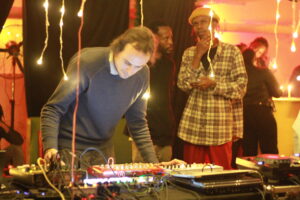
To kick things off, could you walk us through your creative process when working on a new track, especially when using modular synthesis?
Sure. These days, I try not to overthink it, which has been a shift for me. I used to feel like I couldn’t quite conceptualize how to make a piece of music—it felt abstract. But now, I approach it more like a math problem. There’s a need for elements of repetition, obviously. But within that repetition, I want movement, you know?
It’s almost like creating two equations that function together. The first essential element for me is movement. It’s a subliminal feeling, really—one of the most natural reactions to sound. It gives a sense of displacement or just a shift, and it’s powerful.
The issue with using a digital audio workstation (DAW) is that you’re confined to this four-by-four grid. But music wasn’t made to be confined like that. If you and I were to just sit down and say, “Let’s make music in a grid,” it wouldn’t feel right, you know? There’s something limiting about that rigidity.
So for me, I start with movement. Then, I layer in emotion, often through the bassline. I typically build around those two elements. Sometimes I’ll use a synth or a lead, but I prefer starting with the bass—it gives me that emotional depth I’m looking for.
Interesting. So, do you always start with rhythm, then?
Yeah, most of the time I start with rhythm. Bass and percussion form the rhythm section, so I focus there first. For example, I might want to create a polyrhythmic pattern, but it’s actually quite difficult to pull off on just one drum machine. To achieve true polyrhythm, you really need two machines, like running a triplet within a 16/4 pattern. It’s a lot easier to experiment with that kind of complexity on a drum machine or in Ableton.
I think of it as creating a rhythm in motion. Imagine if there were three of us sitting around with drums, playing a syncopated rhythm. For it to sound rhythmic, we’d need to create something called a circular rhythm, making space for every element so they don’t clash. There’s this whole algorithmic side to it too. They even did a research paper showing how an algorithm could generate traditional music by spacing out elements and balancing repetition. Once you get a base pattern, you can overlay another pattern on top of it.
So your melody or whatever is repeating, let’s say every 12 beats. But in techno, you need that little bit of variation. Even if the beat is hard, it has to have that slight volumetric shift, where one pattern might be on a 16th, and another on a 12th, or even a three. It’s that primal sense of rhythm.
Fascinating. And how do you balance your DJ sets with your modular sets?
Honestly, there’s no real balance between the two—they’re completely different approaches. With DJing, you’re looking for loops; you’re curating and blending pre-made tracks to create a vibe. But with modular, you’re creating the music on the spot. You’re essentially composing as you go, paying attention to every detail and reacting to the sounds in real-time.
How do you compare improvisation in your live performances?
Improvisation is where new music is made. I mean, where does improvisation come from? I don’t believe things are improvised, per se; it’s more like you’re realizing probabilities and building on what’s already there, trying different options. It’s weird.
For me, it’s about playing something live, like a pattern, and exploring within it. I think of it as exploring emotions or syntax. The notes might be simple, but they have to be in the right place to feel right.
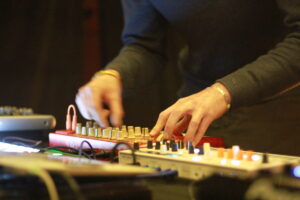
What are your early influences in music? Was it the first piano lessons, or something else?
I started playing guitar at 16, covering bands like Nirvana. It was the late 90s, all about alternative and grunge music. That phase helped me understand music as an emotional syntax. It wasn’t about technique but conveying emotion. Music is a language, and each note and harmony tells a story.
When did you decide to pursue music as a career?
Since I started, I never thought I’d do anything else. I always had the desire to be a musician.
Do you remember your first big gig?
Yeah, it was New Year’s for the millennium. It felt surreal to be paid for performing, almost like a dream.
Which of your tracks has had the biggest impact in terms of audience response?
It’s interesting because I didn’t have any feedback until I put something out. Seeing people react through playlists and analytics is unexpected and great. I was on a Tidal playlist called “African Space Program” with two tracks, Coco Sunshine and another Afrobeat track I did with my friend Sammy Son in Berlin. The response was surprising because I didn’t plan on going in that direction.
How did your collaboration with Edu Madoxx come about?
I just emailed him in 2020 during COVID. He replied a year later, and then we worked through the label. I was in Berlin while he recorded vocals, which I arranged into the song. It was a collaboration across distance, but it worked out.
Are there any other collaborations you’d like to pursue?
There are so many I’d love to do, but the best collaborations happen in the studio, just diving in and creating on the spot.
How do you stay inspired in the electronic music scene?
Meeting other producers and musicians, seeing different techniques and perspectives—that’s what keeps me inspired.
Any local Kenyan music scenes or communities you resonate with?
Yes, Kenyan rhythms and patterns are amazing. Kenya has all these unique rhythms that are almost like techno. The complexity and tempo give it a lot of room for creativity, and it’s something I like to explore in my work.
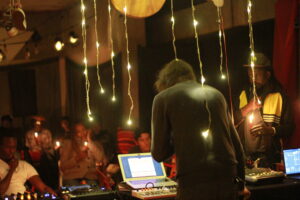
What advice would you give to emerging artists?
Don’t hold back—release your music and collaborate. Make a habit of producing with a goal, like an album or an EP, and set time limits to finish projects. Don’t judge the work too early; focus on the feeling it gives you. And get feedback, even from random listeners—they’ll give you a fresh perspective.
Interview by Caleb Kiteme