
Monrhea: Kindly introduce yourself.
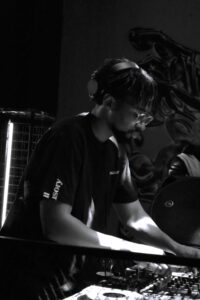
Budalagi: I am Felix Mwita, aka Budalagi, and I am a DJ, Producer, and cultural worker based in Nairobi.
Monrhea: Why “Budalagi”?
Budalagi: Budalagi comes from my gamer tag. Not too long ago I was deep in the online gaming community. I played a lot of GTA—before the pandemic and especially during it. That’s basically all I did beyond school: make music and play games. And I didn’t have the best Internet, so when you’re playing with your friends, the stream would lag a lot. To sum it up, my gamer tag came from my city Internet connection.
Does that “lag” interpret anywhere else in your life—maybe the scene, maybe your journey?
I can definitely get philosophical about that. For me it was about the lagginess—the uptake. When I was starting out, I had a very specific point of view in terms of the music I wanted to hear. I was looking around while making my own music. I’m very introverted, so all I did was go to school, make music, and keep an ear out for parties I’d actually feel comfortable attending. There weren’t many. Some were close to what I wanted to hear, but eventually I had to accept that there’s no perfectly fitting love for you musically—you have to make it. So it became about compromise: finding something aligned enough to be a gateway to what I envisioned.
I wouldn’t say the scene was lagging, but I felt like, “Come on, there’s so much more out there.” More to explore. More sounds to hear beyond the usual. So for me, the lag was collective—this comfort zone, the lack of progressive progressiveness. You’re lagging.
The scene isn’t necessarily lagging in the obvious sense. But personally, I’m aware that I might be lagging in some respects. I have a vision, a mission, an emotional point I want the Nairobi scene to reach. And I feel like that might be lagging too.
So the lag is twofold: frustrations with the scene, and my own stubbornness—this refusal to accept or conform to experiences or emotions that don’t speak to me. I will always lag behind when it comes to conforming to things misaligned with my spirit.
Were you always into electronic music? What’s your story?
My earliest experiences with music were through the radio. My folks had one at home, and whatever they played is what you listened to. A lot of Lingala, old Congolese jazz—my dad loved that. From there it progressed to TV. We had shows like The Beat and other afternoon music shows. I’d come home from school and that’s what would be on. Over time, the music shifted more toward house—music with vibe and flow. And something sparked in me. The intros, the kick, the heartbeat—it was structured, groovy, and it spoke to me. But I didn’t have the language for electronic music yet.
In those days, the exposure was very mainstream. You’d hear an Avicii tune here, some mid-2000s pop-electronic there, Europop influences. There was also what people here called “old school house”—something DJs leaned into. It resonated because it had been popular in the ’90s and ’80s, so our parents had some connection to it. From there, I realized there was this whole world of music built around a four-on-the-floor beat, a kick, a club heart in the bassline, synths. I just kept digging.
I discovered techno and all its subgenres. And I never settled. I’m always curious—looking for the next mutation of the music. I’ve always struggled with the idea of picking one niche subgenre and staying there forever.
Whatever’s in your mind, you can translate it into music. That’s what production became for me: satisfying myself. Making the kind of music I want to hear. Music that speaks to me deeper than words. It became self-expression, a reflection of my taste and identity.
At the core, that’s what artists do—we express ourselves. It’s deeply gratifying to create music I genuinely believe in. And I’ve been intentional about playing my own tracks in my sets. That was always the plan: make music I want to hear played out. That’s my journey, and it’s still evolving.
But once I started making music, I quickly encountered the challenges of navigating a system not always built for artists like me. And then you have to decide: am I going to be helpless and cry about it, or am I going to do something?
So now I’m working on multiple fronts: making music, engaging with the cultural side, the industry side, finding a balance between making the art and shaping the ecosystem around it. It’s not easy. But it’s necessary. That’s just the reality.

Let’s dive deeper into techno.
Mm-hmm.
How would you explain techno to someone, especially the sub-genres you play?
Experiential. It’s an experience before it’s a genre. The sound I play sits in that deep, hypnotic, raw pocket. Very percussive. Very groove-driven. Hard-groove adjacent, if you’re doing your research. But the truth is: it’s contextual. Techno needs a curated space and a curated crowd. The experience makes the music as much as the music makes the experience. My sound is raw, groovy, deep, intricate. Emotional too. When I’m playing, it feels instinctive—almost like going back to something natural.
Techno can also appeal to introverts.
Exactly. It celebrates individualism as much as it celebrates collectivism. Wherever you sit on that spectrum, there’s room for you. In those dark rooms—lit or unlit—no one cares about how you look dancing. The crowd is connected to the music, and people lose themselves in it. It works beautifully for introverts.
From a production point of view—what makes a groove?
For me, it’s polyrhythms. Groove is in the unpredictability. Percussion and syncopation—those are the engines. Syncopation lets you push past familiar patterns. A lot of African music is heavily syncopated and groove-heavy, and that irregularity is something I pull from. If you produce strictly on the grid, it becomes robotic. I try to bring the human element back—drumming live on a Push, tapping rhythms in with my hands.
Everything in the track speaks to each other. The kick talks to the bass. The bass responds to a hat or a stab. You feel when it’s groovy versus linear. Some techno swings heavily; some is rigid and mechanical. I lean toward the swung side because it gets you moving, swaying. And that sway is the heartbeat of techno.
And syncopation—how would you explain it?
At its simplest, it’s one element speaking to another. Call and response. A kick hitting here, a clap landing there, but not where you’d traditionally expect it. It’s hard to explain without demonstrating it, but it’s basically shifting things off the grid so they converse. You can look up the textbook definition, but beyond that, syncopation is the refusal to be linear.
Let’s get into history. You’ve been around the Nairobi scene for a while. What’s your read on the history of techno here—pre-lockdown and post-lockdown?
My first point of reference is Temple and Shelter. That’s where the modern Nairobi techno story starts. A Filipino guy—I’m blanking on his name—introduced that techno night to the city. It was new, novel, fresh. There might’ve been earlier pockets, but Temple was the one that created an actual structure around it.
Around the same time, there was a deep house wave happening—the precursor to the Gondwana era—and that fed into the Afro-house scene we know now. For techno though, Temple was the launchpad. They even did house nights, but the techno nights became the core. That novelty kept it rising until it peaked—right before the pandemic. Those were the golden years.
Temple at its prime was true to the ethos: people expressing themselves freely, dancing, converging, sustaining a culture. It coincided with Nairobi’s EDM golden age, so electronic music in general had oxygen.
Then the demographic shifted. The early adopters got jobs, responsibilities, kids—life pulled them away. Not an excuse; in other places people rave into their fifties without blinking. But here, that first crowd fragmented. Some moved to Afro-house, some drifted into other scenes, some disappeared entirely.
Temple paused, and suddenly techno had no home. People resorted to house parties or even traveling to Europe to hear the sound they loved. Without a regular venue or party series, the culture stalled. Meanwhile, Afro-house grew fast because it was more accessible and more consistent. Every weekend you’d find an event. Techno? Maybe once a month—if that. And without frequency, you don’t get converts.
Now we’re in a second resurgence. A new wave of people want a space for this music—and some of the old heads want to return, or at least pass the baton. But it’s essentially rebuilding from scratch. Without continuity, you have to re-educate, re-contextualize, re-create the culture. Your production sessions, your listening sessions—those give people an entry point. Techno needs that.
So the arc is: novelty, growth, peak, fizzle, fragmentation, and now resurgence.
What makes other scenes work—and what can techno borrow as it rebuilds?
Sustainability comes from a broad user base. Enough people to keep events alive every weekend. Accessibility plays a huge role, and that’s tied to the sonic aesthetic. Afro-house, for example, is easier to uptake for someone encountering electronic music for the first time. I overheard someone once saying during a techno set, “She hasn’t changed the music in ten minutes.” That’s someone who can’t yet hear the layers, the story. They hear a block of sound, not a progression.
Techno asks more of a listener. It’s abrasive, adventurous, unconventional. For someone encountering it for the first time, it’s either “What is this? I want more,” or “This is too much.” And unless there’s regular exposure, that spark doesn’t happen often enough.
Other scenes win through accessibility, regularity, and a culture that welcomes newcomers easily. Afro-house events happen weekly. Techno parties are sporadic. So the probability of encountering techno—and becoming a fan—is low.
Then there’s marketing. Amapiano events look flashy. Afro-house events look warm and communal. Techno flyers usually speak in that “if you know, you know” language. Which is authentic to the ethos, but not always sustainable here. In an ideal world, techno wouldn’t need marketing at all. The community would be the magnet. But Nairobi isn’t there yet.
So it’s sociocultural. It’s systemic. It takes intentionality to enter techno. People like hype, spectacle, belonging. Techno doesn’t sell itself that way by design. And that’s the tension.
Still, the resurgence is real. And the work now is building context, building community, and building continuity—so the culture doesn’t evaporate again.